Sara Chrouf is a co-author on Misraj's family of Arabic-first small models: Kuwain for language injection, Sadeed for diacritization, Mutarjim for translation, Lahjawi for dialects, and Baseer for document reading. One thread runs through them: Arabic first, measurement before claims.
The most interesting problems in AI are not in English.
This is not a slogan: English-centric tokenizers can raise training costs by as much as 68 percent, a finding we build on in the Kuwain paper. The panel below makes the mechanism visible.
The border, live
toy tokenizer
English-centric vocabulary
Arabic-aware vocabulary
كتبOne spelling, at least three readings. This ambiguity is the problem Sadeed was built for.
Toy vocabularies of a few hundred entries; production ratios are smaller, the asymmetry is not.
A good model starts from an honest corpus. For Kuwain we built a full Arabic cleaning pipeline and released it open source, so no team has to reinvent the mop.
Instead of retraining everything, we injected Arabic into an existing small model: added layers and an expanded tokenizer vocabulary, improving Arabic performance by about eight percent on average without losing the English.
Sadeed is a small model finetuned for diacritization on carefully curated data, competitive with far larger proprietary systems. With it we released SadeedDiac-25, because the existing diacritization benchmarks measured less than they claimed.
Mutarjim is a 1.5B model that outperforms systems twenty times its size on Arabic-English translation, released with the Tarjama-25 benchmark. Lahjawi translates across Arabic dialects themselves, because the hardest gap is sometimes inside the language, not outside it.
Baseer is a vision-language model finetuned to read Arabic documents into Markdown, reaching a 0.25 word error rate ahead of open and commercial systems, released with an expert-verified benchmark.
My day job: turning these models into ventures that survive real institutional constraints, from cost and compliance to the dialect gap between user and system. Research that never reaches a user remains unfinished.
The record as published, unpolished: five papers with the Misraj team in 2025, and one from the university years. Every link goes to the source.
01Baseer: A Vision-Language Model for Arabic Document-to-Markdown OCR2025 · arXiv
A VLM finetuned for Arabic document OCR on a large mix of synthetic and real documents, reaching a 0.25 WER and state of the art against open and commercial systems. Released with Misraj-DocOCR, an expert-verified benchmark.
02Mutarjim: Advancing Bidirectional Arabic-English Translation with a Small Language Model2025 · arXiv
A 1.5B translation model built on Kuwain that rivals systems more than twenty times larger, with state-of-the-art English-to-Arabic results on Tarjama-25, our 5,000-pair expert-reviewed benchmark. Ranked paper of the day on Hugging Face.
03Sadeed: Advancing Arabic Diacritization Through Small Language Model2025 · arXiv
A compact decoder finetuned for tashkeel restoration on rigorously cleaned diacritized data, competitive with proprietary LLMs. Includes SadeedDiac-25, a benchmark built after documenting what existing ones fail to measure.
04Kuwain 1.5B: An Arabic SLM via Language Injection2025 · arXiv
Injects Arabic into a small English model by training added layers and expanding the tokenizer vocabulary, gaining about eight percent on Arabic benchmarks while preserving prior knowledge, at a fraction of full-retraining cost.
Translation across Arabic dialects themselves, published at the 4th Workshop on Arabic Corpus Linguistics. The premise: for Arabic users, the hardest border often runs inside the language.
ACL Anthology
06Computational Intelligence-Based Model for Exploring Individual Perception on SARS-CoV-2 Vaccine in Saudi Arabia2022 · Wiley
Undergraduate-era work at Imam Abdulrahman Bin Faisal University: modeling vaccine perception in Saudi Arabia with computational intelligence methods. Where the habit of measuring opinion instead of assuming it began.
From summer-camp robotics to language models, the same coastline the whole way. Lines marked ± have dates for Sara to confirm.
Now
Ventures Manager at Misraj Technology, Al Khobar; MSc candidate in AI. (degree stage to confirm)
2025
The year of five papers: Kuwain and Sadeed in April, Mutarjim in May topping Hugging Face paper of the day, Lahjawi at WACL-4, Baseer in September.
2024 ±
From business development into ventures at Misraj: learning that pricing a model is part of designing it.
2022 ±
Full-stack developer at Intlogy; the vaccine-perception paper published in a Wiley journal, from the university years.
2021
BSc in Computer Science, Imam Abdulrahman Bin Faisal University, Dammam, class of 2017 to 2021.
2019 ±
Research assistant at KACST; robotics trainer and project manager with BrightUP at the Ithra summer camps in Dhahran.
Start
Al Khobar: born, raised, still here. Same window, same sea.
Misraj
Misraj takes its name from the Arabic root for the lamp. A software and AI house in Al Khobar building Arabic-first models and publishing the research and benchmarks in the open. My lane there is ventures: turning what is in the papers into things people use.
The house rule: claim no Arabic capability we cannot measure. So every model ships with its benchmark, and every benchmark ships with the tools for anyone who wants to prove us wrong.
Essays that follow the brush: each starts from a detail we lived while building the models and ends at an institutional question. Written slowly, published when ready.
Designed pieces from inside the identity: three code-drawn posters for our work, and two frames for photographs. Any photo placed here inherits the tide tint automatically, matching the site with no editing.
Poster 01 · a little cosmosPoster 02 · a bridge, both waysPoster 03 · type specimen
Photo frame 01 · Al Khobar corniche · editorial illustration
Photo frame 02 · a desk detail · editorial illustration
The recipe: every photo is desaturated, then color-blended with the deep tide accent, so all photography unifies with the identity regardless of source.
The Room
The personal part. No titles here, no roles; just the place the rest is written from.
A short letter
I work by a window that faces the Gulf. Most of what I believe about Arabic and machines was decided there, late, between a coffee going cold and a model refusing to converge. This site is that desk, tidied slightly for guests.
أعمل قرب نافذة تطل على الخليج. أغلب ما أومن به عن العربية والآلات تقرر هناك، متأخرًا، بين قهوة تبرد ونموذج يرفض أن يتقارب. هذا الموقع هو ذلك المكتب، مرتَّبًا قليلًا من أجل الضيوف.
Now playing
I like working to sound. The radio in the corner of the screen carries three ambiences synthesized in the browser, and two empty slots for my real playlist.
From the window
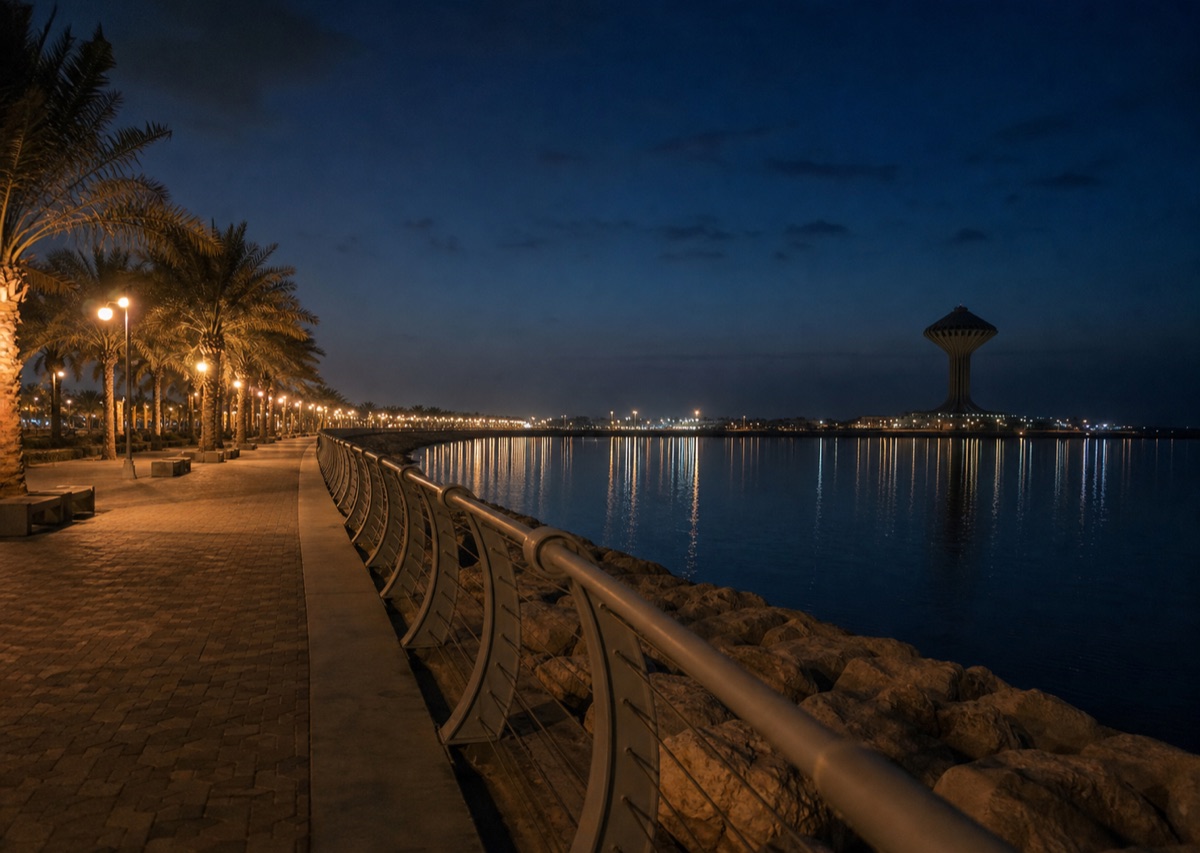
The Khobar corniche after isha: the best meeting room with no chairs in it.
On the desk
The dallahLight Arabic coffee; refilled at every long training run.
Three standing booksKuwain, Sadeed, and Mutarjim: our papers printed and bound, so the problem stays touchable.
The radioNo recommendation algorithm; hand-tuned only.
A small plantThe only thing in the room that grows without adding parameters.
間
My favorite Japanese word: ma (間), the emptiness that makes what surrounds it legible. Its nearest sister in Arabic is sakina: not the absence of sound, but the presence of meaning without a crowd.
One question
An omikuji of open research questions, some of which genuinely keep us up at Misraj. Draw one and take it seriously.
The box holds ten open questions.
Write to Sara
One address for research, speaking, and venture inquiries, read in both languages. It is the address published on our papers.
Sara Chrouf is an Arabic NLP author and Ventures Manager at Misraj Technology in Al Khobar, Saudi Arabia. She is a co-author of Kuwain, Sadeed, Mutarjim, Lahjawi, and Baseer, and of the SadeedDiac-25, Tarjama-25, and Misraj-DocOCR benchmarks, working where Arabic-first research becomes product.
Arabic bio
سارة شروف مؤلفة في معالجة اللغة العربية آليًا ومديرة المشاريع في مسراج للتقنية بمدينة الخبر، حيث وُلدت وتقيم. شاركت في تأليف كُوَين وسَديد ومُترجِم ولهجاوي وبَصير، وفي بناء معايير SadeedDiac-25 وترجمة-٢٥ وMisraj-DocOCR، وتعمل حيث يتحول البحث العربي أولًا إلى منتج.
Preferred description
"Arabic NLP author and Ventures Manager at Misraj Technology, from Al Khobar."
Cite this site
@misc{chrouf2026site,
  author = {Chrouf, Sara},
  title  = {Sara Chrouf: Arabic-first AI, from Al Khobar},
  year   = {2026},
  url    = {https://sarachrouf.com},
  note   = {Al Khobar, Saudi Arabia}
}
Tide mark.
Desk radio
Tide at Fajrgenerative ambience, in-browser
Sounds synthesized in your browser; replace or extend with real files.